Split Beneficiary Clauses in French Life Insurance: The Ultimate Generational Wealth Strategy
How to fully protect a surviving spouse while transmitting major capital to children with double tax efficiency: quasi-usufruct mechanics, notarial agreements, Article 990 I calculation scales, and 2026 financial simulations.

Table of Contents — Strategic Estate Dossier
- 1. The Core Estate Dilemma: Protecting the Spouse vs Providing for the Children
- 2. Civil Law Mechanics: Monetary Quasi-Usufruct (Article 587 of the French Civil Code)
- 3. Tax Treatment on the First Death: Article 990 I & Article 669 Valuation Scale
- 4. Second-Death Estate Leverage: The Restitution Claim (Article 773 of the Tax Code)
- 5. Detailed Numerical Simulation: Standard Clause vs Split Clause on a €600,000 Portfolio
- 6. Tailored Legal Drafting: Indexation, Guarantee Waivers, and Segregation Covenants
- 7. Legal Pitfalls & Tax Compliance: Notarial Registration & Abuse of Law Defense
- 8. Frequently Asked Questions (FAQ) for High-Net-Worth Investors
1. The Core Estate Dilemma: Protecting the Spouse vs Providing for the Children
In family wealth planning, no decision is as delicate as determining how capital should flow upon death. Policyholders of a French life insurance contract (assurance-vie) invariably confront two competing imperatives that create an apparent deadlock:
- Primary spousal protection: Ensuring the surviving partner maintains their customary standard of living, retains complete financial autonomy, and possesses adequate liquidity to manage late-life medical care without depending on relatives.
- Safeguarding the next generation: Preventing family wealth from being eroded by double inheritance taxation or diverted outside the bloodline in the event of a subsequent remarriage.
Confronted with this dilemma, over 80% of policyholders routinely tick the default boilerplate beneficiary clause provided by insurance carriers: "My spouse, failing whom my children, born or to be born, in equal shares, failing whom my legal heirs."
The Hidden Trap of the Standard "Spouse, Failing Whom Children" Clause
This default wording triggers a severe cascade of wealth destruction under French law:
1. Permanent loss of statutory Article 990 I tax allowances: Surviving spouses in France have been entirely exempt from inheritance tax and insurance levies since the 2007 TEPA law. By naming the spouse as primary beneficiary, the valuable €152,500 tax-free allowance per child under Article 990 I of the French Tax Code (CGI) is completely wasted: the spouse does not need it, while the contingent children receive zero.
2. Heavy taxation upon the surviving spouse's subsequent passing: The insurance payout merges into the spouse's general estate. When the surviving spouse later dies, these identical liquid assets face standard French progressive inheritance tax rates (20%, 30%, 40%, and up to 45% above the basic €100,000 allowance per child). The family is taxed twice on the exact same wealth!
This is where sophisticated estate planning introduces its most elegant instrument: the split beneficiary clause (clause démembrée). By legally separating usufructuary rights from underlying capital ownership, it resolves the puzzle: the surviving spouse receives 100% of the funds to manage and spend, while the children are legally and fiscally sheltered from day one.
2. Civil Law Mechanics: Monetary Quasi-Usufruct (Article 587 of the French Civil Code)
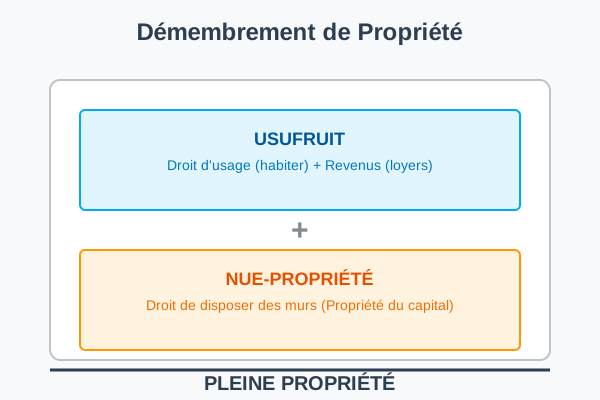
To grasp why this legal mechanism is so robust, one must understand how property rights operate in civil law jurisdictions. When real estate is dismembered, the usufructuary holds the right to occupy the property or collect rental income (usus and fructus), while the bare owner holds underlying title (abusus). The usufructuary cannot sell the property unilaterally because its physical substance must be preserved (Article 578 of the French Civil Code).
However, what happens when the subject matter of the dismemberment is liquid money, such as the cash proceeds distributed on a life insurance death claim?
The Mandatory Qualification as Quasi-Usufruct
Because money is a consumable asset—one cannot use currency without spending it—the French Civil Code applies the specific provisions of Article 587:
"If the usufruct comprises things which cannot be used without being consumed, such as money, grain, or liquids, the usufructuary has the right to use them, but subject to the obligation of returning, at the end of the usufruct, either things of the same quantity and quality, or their estimated value at the date of restitution."
Within the framework of life insurance, the spouse acts as a quasi-usufructuary. In practical terms:
- The insurance company pays 100% of the death benefit capital directly to the quasi-usufructuary.
- The quasi-usufructuary enjoys full discretionary authority over the cash: they can reinvest the capital into other financial contracts, purchase real estate, travel, or spend it on everyday lifestyle needs. The bare-owner children cannot interfere with daily disbursements.
- In immediate legal counterparty, the bare-owner children obtain a restitution claim (créance de restitution) against the future estate of the quasi-usufructuary. This claim is legally equal to the nominal value of capital paid out at the first death.
3. Tax Treatment on the First Death: Article 990 I & Article 669 Valuation Scale
On the tax battlefield, the split beneficiary clause displays exceptional efficiency. For contracts funded prior to the insured's 70th birthday, distributions fall under the regime of Article 990 I of the French Tax Code (CGI).
Under formal administrative doctrine codified in the BOFiP (BOI-TCAS-AUT-60-20140218), tax calculations follow a strict mathematical procedure.
The Statutory Valuation Scale (Article 669 CGI)
The respective taxable values of the usufruct and bare ownership are determined by the chronological age of the usufructuary on the date of the insured's death:
Combining Allowances and TEPA Spousal Exemption
Tax computation upon the first death follows three key stages:
- Proportionate split of the €152,500 allowance: Each couple (usufructuary + bare owner) is allocated a €152,500 allowance divided according to Article 669. For instance, if the surviving wife is 68 (usufruct 40%, bare ownership 60%), the allowance splits into €61,000 for her usufruct and €91,500 for each bare-owner child.
- Total exemption for the surviving spouse: Pursuant to Article 796-0 bis of the CGI (TEPA law), the married spouse or civil partner (PACS) is entirely exempt from the Article 990 I levy. The tax that would otherwise apply to her usufruct share is permanently extinguished.
- Minimal residual tax on children: The children are taxed only on the discounted value of their bare ownership (60% in our example), minus their individual €91,500 allowance. The remaining taxable balance is taxed at the flat rate of 20% (up to €700,000 taxable bracket) and 31.25% thereafter.
SCPI Européennes sans prélèvements sociaux ou Assurance-Vie 0% ?
Comparez les rendements nets réels 2026 et neutralisez la fiscalité de vos revenus locatifs grâce aux SCPI européennes.
Consulter l'analyse comparative →4. Second-Death Estate Leverage: The Restitution Claim (Article 773 of the Tax Code)
While the first-death tax benefits are substantial, the masterstroke of generational planning occurs upon the second death, when the quasi-usufructuary subsequently passes away.
In a conventional estate, liquid cash sitting in bank accounts is taxed at full progressive estate tax rates. Under a split beneficiary arrangement, the restitution claim constitutes a fully deductible debt against the gross estate.
Tax-Free Usufruct Extinction (Article 1133 CGI)
Under Article 1133 of the French Tax Code, the consolidation of usufruct with bare ownership resulting from the death of the usufructuary triggers zero transfer taxes. The children step into full unencumbered ownership of the capital with no additional tax liability.
Estate Passive Deduction (Article 773 CGI)
The restitution debt owed to the children is directly subtracted from the surviving spouse's final taxable estate:
Debt Deduction Mechanics
Assume the surviving spouse passes away leaving total gross assets of €1,000,000 (primary residence, investment portfolios, cash).
With a registered restitution claim of €600,000 from the original life insurance payout:
• Gross estate assets: €1,000,000
• Deductible passive debt (children's claim): - €600,000 (repaid to children 100% tax-free)
• Net taxable estate subject to progressive inheritance tax: €400,000 only!
This debt deduction drastically compresses the final taxable estate, producing immense tax savings for the heirs.
5. Detailed Numerical Simulation: Standard Clause vs Split Clause on a €600,000 Portfolio
To demonstrate the exact mathematical divergence between the two strategies, let us analyze a typical affluent French family scenario in 2026:
- Family structure: Mr. and Mrs. Laurent, married under French statutory community property, 2 adult children.
- Life insurance contract: Subscribed by Mr. Laurent, funded before age 70. Value at death: €600,000.
- Wife's age at first death: 68 years old (Bracket 61–70: Usufruct = 40%, Bare Ownership = 60%).
- Second death: Mrs. Laurent passes away years later, leaving a gross estate of €800,000 (including reinvested insurance proceeds).
Option A: Standard Default Clause ("My spouse, failing whom my children")
1. Upon Mr. Laurent's death:
Mrs. Laurent receives all €600,000. As a surviving spouse, she pays €0 tax (TEPA exemption). The two children receive nothing, and both €152,500 tax-free allowances under Article 990 I are completely lost.
2. Upon Mrs. Laurent's subsequent death:
Her gross estate of €800,000 passes to the 2 children (€400,000 each). After applying the statutory direct-line allowance of €100,000 per child (Article 779 CGI), the taxable base is €300,000 per child.
Applying the progressive French inheritance tax scale:
• Up to €8,072 @ 5% = €403.60
• €8,072 to €12,109 @ 10% = €403.70
• €12,109 to €15,932 @ 15% = €573.45
• €15,932 to €300,000 (€284,068) @ 20% = €56,813.60
Total tax per child: €58,194.35.
Total Family Tax Bill (Option A): €116,388.70!
Option B: Split Beneficiary Clause with Registered Quasi-Usufruct
1. Upon Mr. Laurent's death:
Mrs. Laurent receives the entire €600,000 in quasi-usufruct (100% liquidity). She pays €0 tax.
The 2 children receive bare ownership. Valuation of bare ownership (60%): €360,000, or €180,000 per child.
Pro-rata 990 I allowance per child: 60% of €152,500 = €91,500.
Taxable base per child: €180,000 - €91,500 = €88,500.
20% Article 990 I tax: €88,500 × 20% = €17,700 per child.
Total tax paid on first death: €35,400.
2. Upon Mrs. Laurent's subsequent death:
Gross estate assets: €800,000.
Deductible passive debt (children's restitution claim): - €600,000.
Net taxable estate shared between the 2 children: €800,000 - €600,000 = €200,000 (€100,000 per child).
Applying each child's €100,000 statutory allowance (Article 779 CGI): €100,000 - €100,000 = €0!
Inheritance tax upon second death: €0!
Total Family Tax Bill (Option B): €35,400!
Net Savings for the Laurent Family: €80,988.70!
By tailoring the beneficiary clause and executing a formal quasi-usufruct deed, the family slashes their total tax burden by more than two-thirds, while leaving full control of all €600,000 to the surviving spouse during her lifetime.
6. Tailored Legal Drafting: Indexation, Guarantee Waivers, and Segregation Covenants
Implementing a split clause requires legal craftsmanship. A poorly drafted clause can provoke bitter family disputes or invite tax audits. The three core contractual provisions to consider include:
1. Guarantee Waiver (Article 601 of the French Civil Code)
Unless expressly waived, Article 601 requires the usufructuary to provide financial security to guarantee eventual restitution. To prevent a surviving spouse from being constrained by the children or paying for costly bank sureties, the clause should explicitly state that "the quasi-usufructuary is formally released from any obligation to provide bond or security".
2. Reinvestment Covenants (Obligation de Remploi)
Depending on family harmony, policyholders may choose between two paths:
- Full discretionary spending: Recommended in unified families with high mutual trust. The surviving spouse uses capital freely without justifying investments.
- Mandatory reinvestment: Vital in blended families with children from a previous union. The clause mandates that insurance proceeds be reinvested into segregated dismembered accounts (e.g., capitalization bonds or securities portfolios) requiring joint authorization for capital disposals.
3. Inflation Indexation of the Restitution Claim
If the surviving spouse lives for another 20 years, inflation will erode the real value of a nominal €600,000 debt. Incorporating an indexation clause linked to the French Consumer Price Index (INSEE) preserves purchasing power for the children and boosts the deductible debt amount upon the second death.
7. Legal Pitfalls & Tax Compliance: Notarial Registration & Abuse of Law Defense
The French tax administration inspects estate debt claims with heightened scrutiny. To guarantee complete legal safety, three golden rules must be observed:
Key Compliance Pillars:
1. Mandatory formal deed (Article 773 CGI): Debts owed by a deceased individual to their direct heirs are non-deductible unless certified by an authentic notarial deed or registered private agreement bearing a date certain before death. A notarial quasi-usufruct agreement must be executed promptly after the first death when funds are disbursed.
2. Contributions made after age 70 (Article 757 B): While legally sound, post-70 contributions share a single aggregate €30,500 allowance. The primary benefit lies in shielding investment gains and establishing the deductible restitution claim.
3. Abuse of law defense (Article L. 64 LPF): A split beneficiary clause is entirely legitimate because it serves the primary civil objective of spousal maintenance. French jurisprudence consistently upholds the arrangement provided the documentation accurately reflects real financial flows.
8. Frequently Asked Questions (FAQ)
What is a split beneficiary clause (clause démembrée) in French life insurance?
A split beneficiary clause separates legal rights over the death benefit proceeds: the usufruct (specifically a quasi-usufruct over liquid capital) is designated to a primary beneficiary (typically the surviving spouse), while bare ownership (nue-propriété) is granted to second-tier beneficiaries (usually the children). The quasi-usufructuary receives and freely spends the funds, while the bare owners hold a legal debt claim of restitution deductible from the usufructuary's future estate.
Why is a formal notarial quasi-usufruct agreement legally mandatory?
To ensure the restitution debt is fully deductible from the quasi-usufructuary's gross estate upon their subsequent passing (under Article 773 of the French Tax Code and administrative doctrine BOI-ENR-DMTG-10-40-10-20), the tax authorities strictly require the debt to be certified by a notarial authentic deed or a registered private agreement. Without this formal agreement, the tax administration may disregard the deduction or treat the payout as a taxable gift.
How is the €152,500 Article 990 I tax exemption split under a dismembered clause?
Under French tax doctrine, the statutory €152,500 exemption per beneficiary under Article 990 I is apportioned between the usufructuary and bare owners based on the official age-based tax scale of Article 669 of the French Tax Code (CGI). When the surviving spouse is the usufructuary (completely exempt from inheritance and 990 I tax under the 2007 TEPA law), their share of the exemption cannot be transferred to the children; however, the children apply their pro-rata share of the €152,500 exemption exclusively against the discounted value of their bare ownership.
Can the surviving spouse completely exhaust the funds, leaving nothing for the children?
Under standard quasi-usufruct rules (Article 587 of the French Civil Code), the usufructuary has the legal right to consume the capital entirely. However, the policyholder can safeguard the children's interests by including protective clauses: requiring a reinvestment obligation (obligation de remploi) into specified segregated assets, demanding a financial guarantee (caution bancaire, Art. 601 Civil Code), or indexing the restitution debt to inflation.
Is a split beneficiary clause effective for contributions made after age 70 (Article 757 B)?
Tax advantages under Article 757 B are more modest because the global inheritance tax allowance is capped at €30,500 across all beneficiaries combined. Nevertheless, from a civil and wealth engineering standpoint, the mechanism remains powerful: it shields the surviving spouse while establishing a tax-deductible restitution claim for the children upon the second death, while accrued interest and investment gains remain 100% tax-free.
What happens if the surviving spouse's final estate is smaller than the restitution debt?
The restitution claim is an unsecured debt (créance chirographaire) against the estate. If the assets left by the spouse at death (real estate, investment accounts, cash) are insufficient to satisfy the debt, the bare owners can only recover up to the value of available assets. This highlights why overall family solvency and drafting custom reinvestment covenants must be carefully evaluated beforehand.
Conclusion: Audit Your Beneficiary Designations Today
The split beneficiary clause represents the gold standard in cross-generational French estate planning. It flawlessly reconciles absolute financial security for the surviving partner with substantial tax reductions for the children. However, its effectiveness hinges on precise legal drafting and prompt notarial formalization upon the first passing.
Do not allow standard boilerplate clauses to dictate your family's financial legacy. Have your existing policies reviewed by wealth engineering professionals to insulate your wealth from unnecessary tax erosion.
Thomas, your wealth engineering and estate planning specialist.