
The Patriarch’s Twilight: Why Real Estate Binds Us as Much as It Weighs on Us
It is 7 p.m. The sun slowly sets over the Médoc vineyards, casting copper reflections on the blonde stone facade of the Lefebvre family home. Jean, 68, contemplates this estate that his father passed on to him thirty years ago, and which he himself dreams of bequeathing to his three children. In this house, every creak of the floorboards tells a story: Claire’s first steps, Marc’s tireless studying for his exams, the laughter of little Sophie hidden in the attic.
But tonight, the mood isn't entirely festive. Jean, a man of numbers and caution, has just received a simulation of inheritance taxes from his notary. The figure fell like a guillotine, brutal and cold: for his children to keep this house upon his passing, they will have to pay a tax bill they simply do not have the funds for.
"Sell to pay the tax? Never," he murmurs, gripping the armrests of his old leather armchair. This is a dilemma shared by thousands of French people in 2026. How can you pass on the fruit of a lifetime of work without the State becoming the main heir? How can you protect your children while ensuring you don't end your days in poverty?
It is here, in that quiet office we are used to visiting together, that the most daring solutions are born. And the one we are going to talk about today is undoubtedly one of the most elegant, oldest, and yet most modern in French law: the split ownership (démembrement de propriété). A mechanism that literally allows you to give without becoming poorer.
The "Miracle" of Division: Roman Law Heritage Serving 2026
To understand split ownership, we must take a leap back in time to when Roman legal experts defined the contours of "property." For them, owning an asset was not a monolithic block, but a bundle of three distinct rights:
- Usus: The right to use the thing (to live in it).
- Fructus: The right to perceive its fruits (harvests or, later, rents).
- Abusus: The right to dispose of the thing (to sell, give, or destroy it).
The union of these three pillars forms what we call Full Ownership (Pleine Propriété). But nothing requires these pillars to remain in the hands of one and the same person.
Split ownership consists precisely of splitting this block. On one side, we isolate Usus and Fructus to form what is called **Usufruct** (Usufruit). On the other, we keep Abusus, which becomes **Bare Ownership** (Nue-propriété).
Imagine a magnificent apple tree in Jean’s garden.
- The usufructuary (Jean) has the right to sit in the shade of the tree, to pick the apples to eat them, or to sell them at the market to supplement his income.
- The bare owner (Jean’s children) owns the tree itself, its trunk, and its roots. He knows that one day he will have full enjoyment of it, but for now, he must let his father manage the harvest.
It is this subtle legal choreography that will trigger the most powerful tax levers in the General Tax Code (CGI).
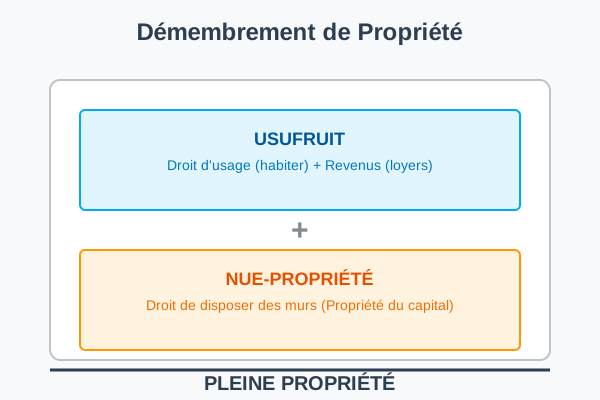
Visualization of the separation between Usufruct and Bare Ownership
The Scale of Article 669 of the CGI: Why Time Is Your Most Precious Ally
In 2026, more than ever, inheritance taxation is a battlefield. Tax allowances have not been increased for years, while real estate prices, although stabilized, remain at historic highs in some regions. As a result, more and more upper-middle-class families find themselves "trapped" by inheritance taxes.
Split ownership offers an escape route thanks to a magical tax rule: the scale of Article 669 of the CGI. When you give the bare ownership of a property while retaining the usufruct, the tax authorities do not ask you to pay taxes on 100% of the property's value. They consider that you are only giving part of the value since you are keeping its use.
This "tax" value of the bare ownership is fixed according to a scale linked to the donor's age at the time of the deed:
- If Jean is between 61 and 70 years old: the usufruct is worth 40% and the bare ownership 60%.
- If he is between 71 and 80 years old: the usufruct is worth 30% and the bare ownership 70%.
- If he is between 81 and 90 years old: the usufruct is only worth 20% and the bare ownership 80%.
The lesson is clear: the earlier you act, the lower the value of the bare ownership you give in the eyes of the taxman. If Jean had acted at age 59, he would only have been taxed on 50% of the value of his estate. At age 68, he is taxed on 60%. Every extra candle blown out on your birthday cake is, in reality, a check you sign to the tax authorities for the future.
Expert Focus: Anticipate to optimize
Split ownership is one of the pillars of our 2026 Wealth Guide. Discover how to couple this strategy with other transmission tools for maximum efficiency.
Case Study: The "Zero Tax" Strategy for a Second Home
Let's take a concrete example, the one that brought a smile back to Jean Lefebvre's face during our last meeting. His Médoc estate is estimated at €600,000. He has three children: Claire, Marc, and Sophie.
Option A: He does nothing.
Upon Jean’s death (assuming he is a widower), each child inherits a share of €200,000.
After applying the legal tax allowance of €100,000 per child, €100,000 remains taxable for each.
According to the progressive scale (brackets from 5% to 45%), each child will have to pay approximately €18,000 in inheritance taxes.
Total for the siblings: €54,000. A sum that could force them to take out a loan or sell part of the land.
Option B: Donation of bare ownership at age 68.
Jean decides to give the bare ownership to his three children.
Tax value of the bare ownership (60% according to the scale): €360,000.
Share passed to each child: €120,000.
Application of the €100,000 allowance: only €20,000 remains taxable per child.
The transfer taxes then amount to approximately €2,200 per child.
Total for the siblings: €6,600.
The gain is spectacular: Jean has "saved" nearly €48,000 for his heirs. Better still: if he had carried out this operation before age 61 (bare ownership at 50%, i.e., €100,000 per child), the bill would have been €0.
But the real "miracle" happens upon Jean’s death. At that moment, the usufruct simply expires. The children become full owners of the entire €600,000 (and even more if the property has increased in value in the meantime), without paying a single extra cent to the taxman. All latent capital gains and the value of the usufruct return to them completely tax-free.
Who Pays What? The Golden Rule of Articles 605 and 606
This is often where family tensions can arise. If Jean remains the usufructuary, who must pay the property tax? Who pays for the roof repair?
The Civil Code is very clear, but it is often misunderstood:
- The usufructuary (Jean) handles "usual" charges: property tax, energy bills, routine maintenance, small repairs (painting, plumbing, garden maintenance). This is the price of his freedom of use.
- The bare owners (the children) handle "major repairs" defined by Article 606: main walls, vaults, restoration of beams and entire coverings (the roof), as well as enclosure walls.
However, for a peaceful transfer, I always advise my clients to insert a derogatory clause in the donation deed. It is entirely possible to provide that the usufructuary will take full responsibility for all work, including major repairs. This avoids asking for financial help from children who may be young or whose financial situation does not allow them to maintain such an estate.
Absolute Protection: Usufruct Reversion to the Spouse
"Thomas, all this is perfect, but if I leave first, will my wife have to leave the estate?" Jean's question is legitimate. In a simple split ownership, upon the donor's death, the usufruct expires. The children become full owners and could, technically, force their mother to sell to recover their share or ask her for rent.
To counter this risk, we use the usufruct reversion clause. During the donation, Jean stipulates that in the event of death, his usufruct will not expire but will be "reverted" to his wife. She then becomes the usufructuary in turn, retaining the right to live in the house or perceive its income until her own final breath.
This is protection of unmatched power, far superior to what a simple will or a classic donation between spouses would allow, because it is carved in stone in the initial donation deed.
Split Ownership Doesn't Stop at Bricks and Mortar: SCPIs and Securities Accounts
While physical real estate is the favorite playground for split ownership, it would be a shame to limit it there. In 2026, more and more savers are using this strategy for their financial assets.
Take SCPIs (Real Estate Investment Trusts). Jean could choose to buy the bare ownership of SCPI shares for his children, while retaining the usufruct. He receives the quarterly dividends to maintain his standard of living, and the children see their capital grow mechanically as the usufruct diminishes, until total expiration.
Better still: the split ownership of securities accounts or capitalization contracts. This is a sophisticated technique that allows you to pass on a stock market portfolio while keeping control over the investment strategy and the generated income. Here, we speak of "quasi-usufruit," a fascinating legal concept that allows the usufructuary to dispose of the funds (sell them, reinvest them) on the condition that he returns an equivalent sum to his children upon his succession. A restitution debt is then recorded as a liability in the estate, further reducing the taxable base.
Pitfalls to Avoid: The Shadow of Abuse of Law
Like any powerful tool, split ownership must be used with discernment. The tax authorities are watching closely. What do they hate above all? Arrangements whose *only* purpose is to evade tax, with no economic or civil reality.
For example, it is strongly discouraged to proceed with split ownership on one’s deathbed (Article 751 of the CGI presumes that if the donor dies within three months following the donation of a property for which he reserved the usufruct, the property is reintegrated at its total value into the estate).
Similarly, if Jean sold his house to his children while reserving the usufruct, the taxman would undoubtedly see it as a disguised donation. The golden rule is this: the deed must be sincere, anticipated, and respond to a real desire to organize one's succession.
Split Ownership Put to the International Test: The Foreign Resident Trap
In our globalized world of 2026, it is not uncommon for one of the Lefebvre children, say Marc, to have gone to build a career in Singapore or Montreal. This is where split ownership can reveal unsuspected complexities.
If the real estate property is located in France, French law applies to the transfer. However, the heir's country of residence may have a very different view of split ownership. Some Anglo-Saxon countries, which do not recognize the usufruct/bare ownership distinction in their civil law (based on *Common Law*), may reclassify the operation as a "Trust" or tax the expiration of the usufruct as a new transfer.
Before signing the donation deed, it is therefore crucial to check international tax treaties. In Marc's case, a thorough analysis would avoid double taxation that would negate the benefits of Jean's strategy. Inheritance is an art that does not stop at the borders of France.
Split Ownership and Property Wealth Tax (IFI): A False Friend?
This is a major point of vigilance for owners of significant estates. Generally, regarding the IFI (Property Wealth Tax), the rule is clear: it is the usufructuary who is taxable on the full ownership value of the property.
For Jean, this means that even if he gave the bare ownership of his estate to his children, he must continue to declare the total value (€600,000) in his taxable wealth for the IFI. The children, for their part, declare nothing.
However, there are notable exceptions. If the split ownership results from a legal succession (and not a voluntary donation), or if the usufruct was sold and not given, the taxation can be split between the usufructuary and the bare owner according to the scale of Article 669.
For taxpayers close to the IFI threshold (€1.3 million in 2026), split ownership may therefore seem neutral or even penalizing. But one must not forget the long-term goal: the massive reduction of future inheritance taxes. The IFI is an annual tax; inheritance taxes are a "once and for all" tax that can amputate the estate by 45%. The calculation is quickly made.
Temporary Split Ownership: Giving a Helping Hand Without Depleting Your Assets
In addition to inheritance transfer, split ownership can be used as a tool for occasional family solidarity. This is what is called temporary split of usufruct.
Imagine that little Sophie Lefebvre starts architecture studies in Bordeaux. Instead of paying her an allowance from his already taxed income, Jean could give her the usufruct of a small rental apartment he owns for a fixed period (for example, 5 or 10 years).
- Sophie directly receives the rents, which finances her studies. She is taxed little or not at all on this income.
- Jean, for his part, no longer receives the rents and therefore reduces his income tax and social security contributions.
- Better still: the apartment leaves Jean's IFI base for the duration of the split ownership!
This is a "win-win-win" strategy that illustrates the incredible flexibility of this legal tool. At the end of the 10 years, Jean automatically recovers full ownership of his apartment, without formalities or taxes.
Summary: The Dashboard for Successful Split Ownership
| Feature | Usufructuary (Jean) | Bare Owner (Children) |
|---|---|---|
| Main Right | Use and income (Rents) | Ownership of the walls (Capital) |
| Transfer Taxation | Pays taxes on his share (if buying) | Pays taxes on the bare ownership |
| Annual Taxation | Property tax, Income tax | None |
| Maintenance (Law) | Routine maintenance (Art. 605) | Major repairs (Art. 606) |
| Wealth Tax (IFI) | Declares 100% of the value (usually) | Declares 0% |
| Upon Death | Expires without taxes | Becomes Full Owner |
Conclusion: Anticipation as an Act of Wisdom
Split ownership is much more than simple tax optimization. It is a philosophy of passing things on. It is the art of passing the torch without letting go of the rail. For Jean Lefebvre, it is the certainty that the walls of the family estate will continue to house the laughter of his grandchildren, without the weight of taxation breaking this precious bond.
In a world where everything is accelerating, where taxation sometimes seems like a labyrinth with no way out, split ownership remains a safe bet, a lighthouse in the storm. But beware: every situation is unique. The split ownership that suits Jean may not be the one that saves you. This is why a fine analysis of your global wealth is essential.
Do not wait for the sun to set to light the lamp. Time is your ally if you know how to tame it, but it becomes your worst enemy if you let it slip away.
To go further and simulate the impact of split ownership on your own wealth, I invite you to consult our dedicated section in the 2026 Wealth Guide or to browse our analysis on Gift-Partition, the other pillar of a successful transfer.
Thomas, your wealth explorer.


Commentaires (0)
Soyez le premier à laisser un commentaire sur cet article.
Laisser un commentaire