
The Notary’s Nightmare: When the Past Comes Back to Haunt the Present
It is 6 p.m. in a quiet notary's office on Avenue Montaigne. Around the table, faces are tense, and eyes are averted. What should have been a simple formality of settling an estate following the death of Robert, the patriarch, is turning into a family drama.
The cause? Two donations made by Robert fifteen years ago. At the time, wanting to help his two children, he had given €150,000 to his eldest son, Lucas, to buy a studio in Paris, and the same amount to his daughter, Emma, to launch her start-up. Perfect equality, he thought.
Except that fifteen years later, Lucas's Parisian studio is worth €450,000, while Emma's business collapsed after a few successful years. When settling the estate, the law is formal: in the presence of "simple donations," one must proceed with the hotchpot (rapport successoral). The donated assets are revalued as of the date of death.
The result? Lucas is considered to have received €450,000, and Emma only €150,000 (the nominal value because the money was spent). To restore balance, Lucas must pay an equalization payment (soulte) of €150,000 to his sister. Lucas, who does not have this sum, will have to sell his studio. Emma, for her part, feels wronged by fate. The sibling bond is broken. Robert, who wanted peace, has sown discord.
This tragic situation, which we encounter all too often, has a sovereign remedy: the Gift-Partition (donation-partage).
The "Freezing" Mechanism: Stopping Time to Preserve Harmony
The Gift-Partition is a unique "hybrid" act in French law. It is both a donation (you give during your lifetime) and a partition (you definitively distribute the lots among your presumptive heirs).
Unlike a simple donation, the Gift-Partition possesses a legal superpower: it freezes values as of the day of the donation.
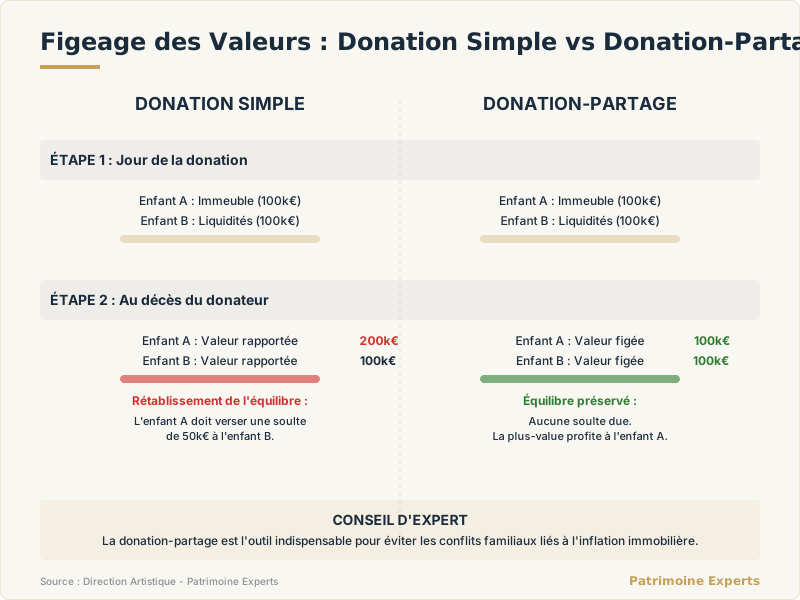
If Robert had carried out a Gift-Partition in 2011, allocating the studio to Lucas and the funds to Emma, the value retained during his succession in 2026 would have remained €150,000 for each. It doesn't matter that the studio is now worth a million or that the company went bankrupt. Family peace is sealed the day the deed is signed at the notary's office. No one owes anyone anything. Equity is respected because it was decided and accepted by everyone during the donor's lifetime.
Expert Focus: Securing your transmission
The Gift-Partition is the preferred tool detailed in our 2026 Wealth Guide. Learn how to use it to protect your heirs' harmony.
2026 Taxation: Optimizing Allowances Without Pain
In 2026, Gift-Partition taxation remains one of the most powerful levers for transferring significant capital without lining the taxman's pockets.
The central pillar remains the tax allowance of €100,000 per parent and per child. What is often ignored is that this allowance is "renewable" every 15 years. A couple can therefore pass on €400,000 to their two children without paying a single cent in transfer taxes.
In a Gift-Partition, you can mix different types of assets: real estate, cash, company shares. If the lots are not of perfectly identical value, the person receiving the most can pay an equalization payment (soulte)—a sum of money—to the person receiving the least. This equalization payment, if paid immediately, is very tax-advantageous.
Better yet: the Gift-Partition can cover assets you own through split ownership (bare ownership). By coupling the Gift-Partition with the reservation of usufruct (which we explored in our dedicated article on split ownership), you reach the summit of wealth optimization. You transfer the bare ownership, you freeze the values, and you keep the income until the end of your days. It’s the "Grand Slam" of wealth management.
Transgenerational Gift-Partition: The Fiscal Leapfrog
This is the big trend of 2026: helping grandchildren rather than children. Why? Because our children often inherit at an age (50s or 60s) when they are already established in life. It is the grandchildren, in the middle of their start (studies, first purchase), who need capital the most.
Transgenerational Gift-Partition allows you to "skip" a generation. With your child's consent, you give all or part of their share directly to their own children (your grandchildren).
The advantage is twofold:
- Civil: You help those who need it at the appropriate time.
- Fiscal: You avoid double taxation. If you give to your child, who then gives to their own child later, the taxman will take his share twice. By giving directly to the grandchild, the tax is paid only once.
Each grandchild benefits from an allowance of €31,865 (cumulative with the parents' allowance). For a family with four grandchildren, more than €125,000 can be transferred completely tax-free while freezing the values.
Why Going to a Notary Is Your Best Investment
Some clients tell me: "Thomas, notary fees are expensive." I systematically reply: "Compare them to the cost of an inheritance lawsuit or transfer taxes at 20% or 30%."
The notary is not just a tax collector. He is the architect of your family peace. His role in a Gift-Partition is crucial:
- He verifies that no heir is wronged regarding their forced heirship (réserve héréditaire) (the minimum share the law guarantees to each child).
- He drafts tailor-made clauses: right of reversion (if the child dies before you), prohibition on disposal (to prevent the property from being sold too quickly), or an exclusion from community property clause (so the property stays in the family even in the event of the child's divorce).
- He ensures land registration and the total legal security of the operation.
In 2026, with the increasing complexity of families (blended, expatriate), a notary's advice is more indispensable than ever. A poorly constructed Gift-Partition is a ticking time bomb. A well-made Gift-Partition is a safe for your legacy.
Conjoint Gift-Partition: The Strength of Union
This is a variant often overlooked but tremendously effective for married couples: the Conjoint Gift-Partition (donation-partage conjonctive). In this arrangement, both parents pool their assets (whether they belong to one or the other, or are communal) to perform a single partition among their children.
The interest is major: you can allocate an asset belonging to the father to one child, and an asset belonging to the mother to another, while considering the operation as a single, inseparable whole. This makes it much easier to balance the lots, especially when the estates of the two spouses are disparate. In 2026, with the increasing number of families owning assets inherited from different lineages, the Conjoint Gift-Partition stands out as the ultimate wealth-merging tool.
The Equalization Payment Mechanism: Fine-Tuning Adjustment
It is rare for an estate to be cut into perfectly equal shares. How can you give a house worth €300,000 to one and an apartment worth €200,000 to another without creating injustice? The answer lies in one word: the equalization payment (soulte).
The person who receives the larger lot (the "over-taker") agrees to pay a sum of money to the person who receives less. This equalization payment can be paid immediately with personal cash or be stipulated as a debt.
However, beware: in 2026, with market volatility, I often advise indexing the equalization payment or providing for flexible payment terms. If it is not paid on the day of the deed, it can produce interest. It is a precision tool that allows for perfect mathematical equality, thus extinguishing any future grounds for contestation.
Business and Transfer: The Marriage of Gift-Partition and the Dutreil Agreement
For business owners, passing things on is a puzzle. How can you transfer company shares to the child taking over without harming their siblings who don't work there?
The solution lies in coupling the Gift-Partition with the Dutreil Agreement (Pacte Dutreil). In 2026, the Dutreil Agreement still allows, under certain conservation commitment conditions, for a 75% tax allowance on the value of the transferred shares.
By integrating these shares into a Gift-Partition:
- You massively reduce transfer taxes thanks to the Dutreil Agreement.
- You freeze the value of the company shares. If the successor child makes the company grow and multiplies its value tenfold, they will have nothing to return to their siblings during the succession.
- You balance the partition by allocating real estate or financial assets to the other children.
This is the favorite strategy of entrepreneurs who wish to ensure the continuity of their work tool while maintaining family harmony.
Blended Families: Gift-Partition as a Factor for Peace
In a blended family, succession is often a minefield. Children from a first marriage may feel threatened by the new spouse or by children born from the new union.
The Gift-Partition is a tool for social pacification here. It allows for the inclusion of all children (those of both parents and those of only one) in the same deed, with everyone's agreement. This is called a distributional Gift-Partition.
It allows for clarifying everyone's rights "during one's lifetime" and avoiding lawsuits for reduction that often poison complex successions. In 2026, where nearly one in ten families is blended, this act is no longer an exception but a necessity to prevent wealth from becoming the catalyst for old grudges.
Conclusion: Wealth Is a Bond, Not a Burden
Passing things on is not just about distributing assets. It is about passing on values, a story, and above all, the certainty that the family will remain united after we are gone.
The Gift-Partition is the tool of choice for those who believe that their wealth should be a driver of success for their descendants, and not a poison that will divide them. By freezing values and organizing the partition during one's lifetime, one removes from heirs the burden of comparison and resentment.
If you have children, if you own assets with disparate values, or if you simply wish to see your grandchildren flourish thanks to your help, the 2026 Gift-Partition is your best ally.
As I often say: you don't prepare your succession for yourself; you prepare it for those you love. Don't leave them a puzzle with the most important pieces missing.
For a personalized study of your family and tax situation, do not hesitate to consult our 2026 Wealth Guide. And remember: when it comes to wealth, silence is often the beginning of conflicts. Talk to your loved ones, and act while you still have control.
Thomas, your wealth explorer.


Commentaires (0)
Soyez le premier à laisser un commentaire sur cet article.
Laisser un commentaire