2026 Life Insurance Awards: Which Euro funds beat inflation in 2025?

In this month of January 2026, an unusual buzz fills the towers of La Défense and the quiet headquarters of insurance mutuals. The figures are coming in, one after another, like pieces of a complex puzzle drawing the new face of French savings. It's time for the final count. For millions of savers, their annual life insurance statement is no longer a mere administrative formality, but the verdict of a year of profound financial shifts.
Remember the atmosphere three years ago: euro funds were moribund, rampant inflation was devouring capital, and advisors swore only by Unit-Linked funds. But 2025 was the year of confirmation. The year where the "old" euro fund proved it still had some spring left, driven by a rise in rates that insurers finally started to pass on massively. This ranking, the result of a rigorous analysis of the performance of over 100 contracts, is what we are revealing to you today.
Through this "Grand Format" guide, we go beyond simple numbers. We explore the strategies that allowed some players to cross the symbolic 4% mark, while others struggle to wake up from their lethargy. Whether you are a cautious saver or a seasoned investor, these 2026 awards are your compass for steering your wealth in this new year.
2025 Review: A year of confirmation for euro funds
If we had to summarize 2025 for life insurance in one word, it would be: Renaissance. After a transition year in 2024, 2025 saw market average yields firmly establish themselves between 2.6% and 2.9% (before social charges), compared to barely over 2% the previous year. But behind this average lie spectacular disparities.
The "ratchet" effect of bond rates
The mechanics are relentless. Life insurers manage giant stocks of bonds. When rates go up, it takes time for new, higher-yielding bonds to replace the old ones in the "belly" of the contracts. In 2025, we reached this tipping point. Insurer portfolios fully benefited from the bond yields of 2023 and 2024, injecting new life into euro funds.
Thomas's view: "2025 was the year where savers' patience was rewarded. Those who didn't give in to the low-rate panic saw their yield double in two years. This is the power of the positive inertia of life insurance."
The bonus war: the weapon of mass seduction
To attract fresh capital, insurers did not hesitate to bring out the big guns. In 2025, the practice of "top-up bonuses" became widespread. Offers promising +1.50% or even +2.00% additional yield on the euro fund, subject to a minimum share of Unit-Linked funds, flourished. For agile investors, this allowed global yields to exceed 4.5% on the secured portion. A historic windfall.
The Top 10 Most Performing Contracts in 2025
Here is the long-awaited verdict. This ranking was established taking into account yields net of management fees, but before social and tax levies. We prioritized contracts accessible to the majority (entry ticket under €5,000).
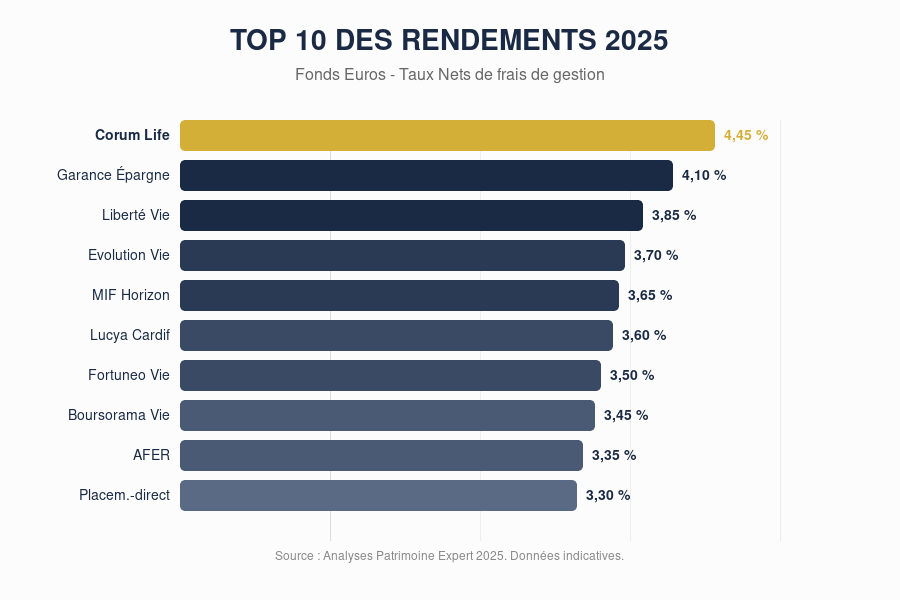
| Rank | Contract Name | Insurer / Distributor | 2025 Rate (Net) | Expert Rating |
|---|---|---|---|---|
| 1 | Corum Life | Corum L'Épargne | 4.45 % | ★★★★★ |
| 2 | Garance Épargne | Garance Mutuelle | 4.10 % | ★★★★★ |
| 3 | Liberté Vie | Spirica / Linxea | 3.85 % | ★★★★☆ |
| 4 | Evolution Vie | Abeille Assurances / Assurancevie.com | 3.70 % | ★★★★☆ |
| 5 | MIF Horizon | MIF | 3.65 % | ★★★★☆ |
| 6 | Lucya Cardif | BNP Paribas Cardif / Assurancevie.com | 3.60 % | ★★★☆☆ |
| 7 | Fortuneo Vie | Suravenir / Fortuneo | 3.50 % | ★★★☆☆ |
| 8 | Boursorama Vie | Generali / BoursoBank | 3.45 % | ★★★☆☆ |
| 9 | AFER | Abeille Assurances | 3.35 % | ★★★☆☆ |
| 10 | Placement-direct Vie | Swiss Life / Placement-direct | 3.30 % | ★★★☆☆ |
*Yields net of management fees, excluding social charges. Past performance is not indicative of future results.
Online Banks vs Traditional Insurers: The 2025 Matchup
A fine analysis of these awards reveals a major trend: the gap is widening between different types of players. In 2025, where you hold your contract had a massive impact on your wealth.

Online Brokers
Domination through reduced fees and agility.

Mutuals
Strength of the collective and absence of shareholders.

Retail Banks
Slow wake-up and heavy bond stock.
The insolent domination of online brokers
With management fees reduced to a minimum (often 0.60% compared to 0.85% or 1% in physical networks) and superior technological agility, online brokers (Linxea, Assurancevie.com, Placement-direct) are sweeping the board. Their contracts, often insured by specialized subsidiaries (Spirica, Suravenir), were able to pass on the rate hike faster. For the saver, the gain is double: more yield and fewer fees.
Mutuals: the strength of the collective
Players like MIF or Garance continue to play the spoilsport. Their mutual status allows them not to have shareholders to remunerate, and thus to redistribute a larger share of profits to policyholders. In 2025, they proved they were the best guardians of the purchasing power of cautious savers.
Retail banks: a slow awakening
This is the dark spot of these awards. While major French banks have started to raise their rates, they remain mired in high management fees and a stock of old bonds that are harder to digest. Many "in-house" contracts from large banking networks are still stagnating below 2.5%, less than the Livret A. If your contract is in this category, it is urgent to question its allocation.
Zoom on the podium: Why they won in 2025
To understand how such performance is achieved, you have to look under the hood. The top three in our ranking are not there by chance; they embody three different but winning visions of modern life insurance.
1. Corum Life: The agility of a "pure player"
The big winner of the year, Corum Life, benefited from its youth. Having no "old" contracts to manage nor stocks of 0% bonds dating from 2021, the insurer was able to invest massively from its inception in high-yield assets. In 2025, Corum continued its momentum by integrating very opportunistic management of corporate bonds (High Yield). It's a "commando" contract: reduced management fees, no entry fees, and total transparency on the composition of the euro fund. It is the typical example of a contract that knew how to capture the rise in rates in real time.
2. Garance Épargne: The revenge of the mutual model
Garance is not an insurer like the others. Coming from the world of craftsmanship, this mutual has always favored "good family man" but extremely rigorous management. Its 4.10% performance in 2025 is the fruit of a very generous reserve policy (PPB). Unlike a stock-market-listed bank, Garance has no dividend requirement. Every euro earned on the markets is either put in reserve for hard times or redistributed. In 2025, the mutual decided to strike hard to mark its territory. It is the choice of security boosted by mutual ethics.
3. Linxea Avenir (Spirica): The technological Swiss Army knife
Behind Linxea is the insurer Spirica (a subsidiary of Crédit Agricole), which was one of the first to revolutionize the euro fund with its "New Generation" version. By accepting a capital guarantee of 98% or 97% (with management fees being deducted), Spirica was able to go for slightly higher-yielding assets. In 2025, this bet paid off. The Linxea Avenir 2 contract has become the preferred support for "finance geeks": access to hundreds of ETFs, top-tier SCPIs, and a management interface that allows you to pilot your savings like a pro trader from your smartphone.
Deciphering your annual statement: The lines they don't want you to read
January is also the month for receiving the annual information statement. It is an often austere document, but it contains crucial information. Don't just look at the final amount.
The profit-sharing rate
This is the "true" yield. It is often broken down into a technical (guaranteed) rate and profit-sharing (the bonus). In 2025, some insurers were opaque about the share of profits they kept in reserve. If your insurer displays a low yield but you see its reserves (the PPB) exploding, it's because it is "depriving" you of part of your due to prepare its future marketing. You are right to ask questions.
Total real fees
Look for the line "Fees charged for the year". Add up the contract management fees, internal fund fees (UL), and any switching fees. In 2025, we found that some contracts displayed a nice 3% on the euro fund, but auxiliary fees ate away nearly 1.2% of the total value of the contract. The net-net yield then becomes disappointing. A forewarned saver is worth two: gross performance is just a mirage if fees are a bottomless pit.
Life Insurance vs Other Investments: The 2025 comparative review
To put our awards in perspective, let's look at how the other major pillars of your wealth performed over the past year.
| Investment | Average 2025 Yield | Wealth Experts Verdict |
|---|---|---|
| Livret A / LDDS | 3.00 % (net) | Unbeatable for emergency savings, but capped. |
| PEA (World Stocks) | +8.5 % | Excellent performance, but with 15% volatility. |
| Direct Real Estate (Paris) | -2.0 % (price) | The year of the purge. Rents barely compensate. |
| Bitcoin / Crypto | +45 % | For the strong-hearted only. Out of category. |
| Euro Funds (Top 10) | 3.80 % | The best Risk / Reward ratio of 2025. |
As we can see, the top tier of life insurance (our Top 10) beats the Livret A. This is a historic shift. Since 2021, the Livret A systematically beat life insurance. In 2025, the hierarchy is restored. Life insurance becomes once again the base investment for any capital exceeding the €23,000 ceiling of the Livret A.
Taxation: What really stays in your pocket
Never forget that the taxman is your first "partner". In France, life insurance interests are subject to social charges (17.2%) as soon as they are credited to the account for the euro fund.
If you hold a contract for more than 8 years, you benefit from the annual allowance on withdrawals (€4,600 for a single person, €9,200 for a couple). In 2025, with rising yields, many savers crossed these thresholds unintentionally. Fine management of your withdrawals in 2026 will be necessary to optimize your taxation. Thomas advises you to "purge" your capital gains every year to take full advantage of these allowances, a legal and formidably effective technique.
Marc's Story: Why the displayed yield isn't everything
To understand the subtlety of the 2025 awards, let's step away from Excel spreadsheets and meet Marc. Marc is 58, an industrial manager actively preparing for retirement. At the beginning of 2025, Marc held a "dusty" life insurance policy in his historical bank, which earned him a painful 1.80%. Frustrated, he decided to act.
But instead of just looking for the highest rate, Marc looked at the conditions. He discovered that to get the "Grail" of 4% from some insurers, he had to invest 50% of his capital in Unit-Linked (UL) funds, which are not guaranteed. For a cautious profile like his, the risk seemed high. This is where strategy comes in.
Marc opted for an online contract (number 3 in our ranking). By taking advantage of a welcome offer and selecting very stable real estate UL funds (SCPI), he managed to get a weighted yield of 3.95% on his entire contract, while sleeping soundly. The lesson from Marc's story? The ranking is a base, but the contract's architecture is your real performance engine.
Yield Bonuses: The flip side of the coin
Browsing through advertisements in 2025, you probably saw amazing rates, sometimes flirting with 5%. Be careful, however, not to confuse "base rate" with "boosted rate".
The "give-and-take" policy
Most of the top-tier performances in 2025 come with conditions. The insurer agrees to give you a larger share of its profits if, in exchange, you agree to direct part of your savings toward funds from which it earns higher margins (UL). This is a legitimate strategy, but one that requires increased vigilance on the quality of these famous UL funds. Investing in a 4% euro fund makes no sense if the accompanying UL portion loses 10% over the year.
Top-up bonuses vs Assets under management bonuses
A frequently ignored subtlety in 2025 was the distinction between bonuses applied only to new deposits and those applied to the entire capital already present in the contract. "Old" loyal savers were sometimes the forgotten ones of the party, with the best rates reserved for "conquering" new clients. This is why we advise, in 2026, not to hesitate to open a new contract rather than fueling an old, less generous one.
Real Estate in Life Insurance: The big comeback in 2025
One cannot analyze the 2025 awards without mentioning the place of "paper-stone" (SCPI, SCI, OPCI). After a year of price purging in 2023 and 2024, 2025 marked a healthy stabilization.
The contracts that performed are those that knew how to integrate "new generation" SCPIs, without entry fees and invested in growing sectors like health or European logistics. Within life insurance, these supports offered yields distributed around 4.5% to 5.2% in 2025. Combined with a solid euro fund, they form the "winning duo" of the past year.
For those who prefer physical real estate to paper-stone, don't miss our 2026 comparison of Pinel, Denormandie, and LMNP schemes.
2026 Outlook: Should we expect a further rise?
The question on everyone's lips at the beginning of this year: will the party continue? According to our analysis, the answer is a nuanced "yes."
ECB key rates seem to have reached a plateau. However, the "drainage" effect from old bonds to new ones will continue to play in favor of euro funds for another 18 to 24 months. We anticipate for 2026 a market average that could cross the 3% mark, with the best contracts stabilizing around 4% without excessive bonus gimmicks.
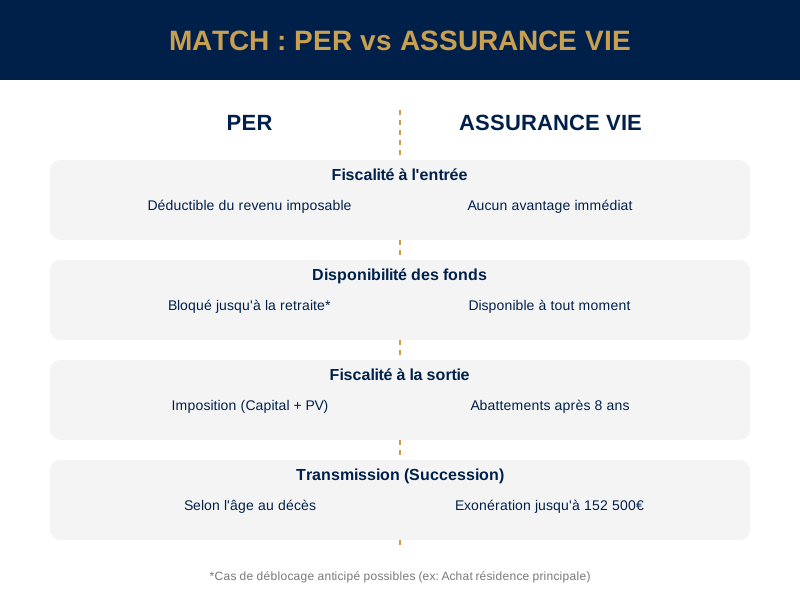
To optimize your strategy, don't forget to compare this investment with the Retirement Savings Plan (PER), which offers additional tax advantages.
Wealth Experts 2026 Forecast
The game will no longer be played on gross yield, but on the capacity of insurers to offer performing discretionary management based on ETFs (trackers). Life insurance is becoming a global financial hub. The euro fund will no longer be the only destination, but the secured starting point of a more offensive strategy.
Conclusion: Your roadmap for acting now
The 2025 awards are not just a trophy for insurers; they are a warning signal for immobile savers. If your contract displays less than 2.5% this year, you are losing money compared to the market's real potential.
Your 5 priority actions in 2026:
- Check your rate: Don't settle for "hearsay." Look at your 2025 annual statement.
- Compare fees: If you are paying more than 0.75% in management fees, you are financing your banker's lifestyle, not your retirement.
- Open a "purely online" contract: Even with a small sum (often €500), take a stake in the leading contracts from our ranking.
- Negotiate bonuses: If you have significant capital to deposit, call your advisor. In 2026, everything is negotiable.
- Diversify with discernment: The euro fund is back, but don't put all your eggs in one basket. ETFs and SCPIs remain essential for beating inflation over the long term.
Life insurance regained its nobility in 2025. It is now up to you to transform this collective performance into individual success.
Thomas, your wealth explorer.


Commentaires (0)
Soyez le premier à laisser un commentaire sur cet article.
Laisser un commentaire