Marc's Dilemma: A Night at the Crossroads
It was 6:30 PM this Tuesday in February 2026. Marc, a 45-year-old senior executive, was contemplating the horizon from his 12th-floor office. Before him, a bank statement displayed a cash surplus he had patiently accumulated. Yet, Marc was facing a dilemma that haunts millions of French savers: where to put this money so it truly works for him?
Life Insurance, the timeless grand dame of French wealth? Or the Retirement Savings Plan (PER), the aggressively tax-efficient challenger that has been gaining ground since the PACTE law?
In 2026, the game has changed. Inflation has stabilized around 2.2%, interest rates have begun a slow decline after the peaks of 2024, and new tax brackets are reshuffling the cards. Choosing between these two vehicles is no longer a question of "better" or "worse"; it's a question of surgical strategy.
1. Life Insurance: Absolute Freedom
Let's start with what Marc knows well. Life Insurance. Often described as the preferred investment of the French with over €1,900 billion in outstanding balances, it owes this title to one fundamental characteristic: freedom.
The Sensation of Liquidity: A Myth to Debunk
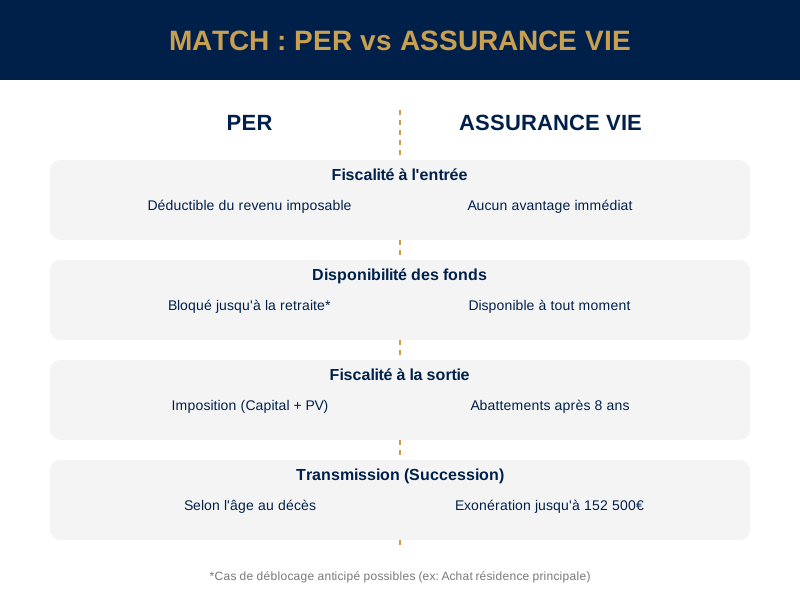
Contrary to hard-dying misconceptions, money placed in life insurance is never locked. Marc can decide, tomorrow morning, to proceed with a full or partial withdrawal. While taxation is optimal after eight years of holding, access to capital remains permanent.
In a world where crises follow one another with metronomic regularity, this "exit door" always left ajar is an invaluable psychological luxury. It's the famous digital "nest egg" that allows for a good night's sleep.
The Inheritance Paradise: The Ultimate Wealth Weapon
Life insurance is, by nature, "outside the estate." For Marc, this means he can transfer up to €152,500 per beneficiary without the State taking a single cent on sums paid before his 70th birthday. Imagine Marc has three children. He can transfer a total of €457,500 to them completely tax-free. Try doing the same with a brokerage account or direct real estate, and you'll see the taxman rubbing his hands with glee.
2. The PER: The Tax Shield
Against this freedom, the PER opposes a formidable weapon: immediate tax deduction. It's the savings turbo for those who are heavily taxed.
The Faustian Deal with the State
Imagine Marc. His Marginal Tax Rate (TMI) is 30%. If he pays €10,000 into his PER, he reduces his taxable income by the same amount. The result? An immediate tax saving of €3,000. Marc is not investing €7,000; he is investing €10,000 which will generate interest on the entire sum, but the actual savings effort is only €7,000.
The Counterpart: The Retirement Tunnel
But beware, the rule is strict. The PER is a tunnel contract. The money is locked until retirement liquidation. That's the price of the tax advantage. However, Marc can unlock his capital early for the purchase of his primary residence. It's a formidable lever: he uses money he should have paid in taxes to finance his own roof.
Comparative simulation of net gain after 20 years (30% TMI).
3. Technical Match: Numerical Simulations
The verdict is final for an executive like Marc: the PER offers a 20% higher profitability lever thanks to the reinvested tax saving, provided that the TMI at exit is not higher than at entry.
4. The Contract Jungle: Beware of Fees
Marc shouldn't just choose between PER and Life Insurance; he must choose the right contract. A contract with 3% entry fees and 1% annual management fees will literally "eat" his performance. Avoid entry fees. Favor online brokers who display reduced management fees (0.6% or less).
5. Summary Table: The 2026 Ultimate Comparator
| Feature | Life Insurance | PER |
|---|---|---|
| Availability | Permanent | Locked (except exceptions) |
| Entry Advantage | None | IR Tax Deduction |
| Exit | Taxation on gains only | Capital and gains taxed |
| Inheritance | Outside estate (Allowance) | Integrated (with specific allowances) |
Conclusion: The Art of Mixing
The winning strategy in 2026 is intelligent mixing. For Marc, we recommended 50% in Life Insurance for flexibility and 50% in PER for the tax boost. Like Marc, don't let your savings sleep. Ask yourself about your future and adjust your sliders.



Commentaires (0)
Soyez le premier à laisser un commentaire sur cet article.
Laisser un commentaire