Passing on without Betraying: Optimizing your Succession through Property Dismemberment
How to protect your loved ones' future without sacrificing your own quality of life.

For Pierre and Hélène, the house on the Île de Ré is not just a simple real estate asset. It is the theater of thirty years of family vacations, the place where their children learned to swim and where their grandchildren now hunt for crabs. At 72 and 70 years old, the couple is beginning to think about what comes after. "We want this house to stay in the family," Pierre explains. "But when we see the inheritance tax simulators, we are afraid that our children will be forced to sell it to pay the tax."
Pierre and Hélène's situation is that of millions of French people. France has one of the heaviest inheritance tax systems in the world, and without anticipation, the legacy of a lifetime can be cut by 20%, 30% or even 45% by the State.
Yet, there is a legal tool of formidable effectiveness, often misunderstood in its finesse: property dismemberment. This is the solution that allows you to pass on "the walls" while keeping "the keys." It is the art of giving without divesting oneself.
Understanding dismemberment: Usufruct vs Bare ownership
In French law, full ownership of a property is like a bundle of rights that can be separated. Dismemberment consists of dividing this bundle into two distinct parts:
- Usufruct: It is the right to use the property (live in it) and to perceive the income from it (rent it out). By retaining the usufruct, Pierre and Hélène keep total enjoyment of their house. They decide everything, can spend the summer there, and if they decide to rent it, the rents belong to them.
- Bare Ownership: It is the right to dispose of the property in the long term, but without having immediate use of it. This is what the children receive. They own the walls, but they have no say in the occupation of the property as long as the parents are alive.
The legal \"miracle\" occurs at the death of the usufructuary: the usufruct expires and joins the bare ownership to reconstitute full ownership in the hands of the children. And this, without any additional inheritance tax. All the tax was settled (or erased via allowances) on the day of the initial donation.
The tax advantage: The power of Article 669 of the CGI
Why is dismemberment so powerful fiscally? Because you only pay taxes on a fraction of the value of the property.
The tax administration uses a scale (Article 669 of the General Tax Code) which fixes the value of the usufruct according to the age of the donor. The earlier you give, the less the bare ownership has fiscal value, and the less you pay in duties.
For example, for Pierre and Hélène who are between 71 and 80 years old, the usufruct is estimated at 30% of the value of the property. If they give the bare ownership of their €1,000,000 house, the taxable base is only €700,000. By using their allowances of €100,000 per parent and per child (i.e., €400,000 for their two children), they only pay duties on €300,000.
If they had waited until their death to pass on full ownership, their children would have been taxed on €1,000,000, with a tax bill two to three times higher.
Expert Focus: Anticipate to optimize
Split ownership is one of the pillars of our 2026 Wealth Guide. Discover how to couple this strategy with other transmission tools for maximum efficiency.
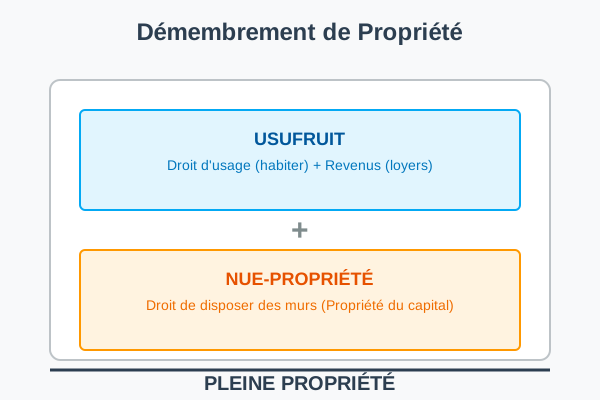
Visualization of the separation between Usufruct and Bare Ownership
Practical case: Passing on a portfolio of SCPI/REITs
Dismemberment does not only apply to physical stones. In 2026, it is increasingly used for SCPI shares.
Imagine that Pierre and Hélène hold €200,000 in SCPIs that pay them €9,000 in income per year. They can give the bare ownership of these shares to their children.
- For the parents: They continue to receive the €9,000 per year until the end of their lives. Their quality of life is protected.
- For the children: They become owners of the shares. At the death of the parents, they recover full ownership and income, without paying a penny to the taxman.
This is a \"double-trigger\" strategy: the parents' present is protected and the children's future is secured.
Conclusion: Anticipation, the ultimate tool for family peace
For Pierre and Hélène, the visit to the notary was a release. \"The greatest benefit is not only fiscal,\" admits Hélène. \"It is peace of mind. We know that the house is safe, that the children will not have any conflict with the tax administration, and we continue to gather the whole tribe there every summer.\"
Wealth transfer is not a question of figures, it is a question of values. Passing on without betraying your own comfort is possible thanks to wealth engineering. In 2026, with increasing life expectancy and economic uncertainty, the donation of bare ownership is establishing itself as the ultimate tool for family peace.
To anticipate is to love. And you, have you already dismembered to better protect?
Thomas, your expert in wealth strategies.
Commentaires (0)
Soyez le premier à laisser un commentaire sur cet article.
Laisser un commentaire