As we reach the middle of 2026, if you listen closely in the quiet corridors of London’s City or Paris’s financial districts, or if you browse investor forums, one phrase keeps recurring like an incantation: 2026 wealth diversification strategy. And for good reason: after last year's monetary turbulence and the reshuffling of geopolitical cards, any investor betting on a single horse is no longer showing boldness, but recklessness.
There is a famous adage in finance, often attributed to Nobel laureate Harry Markowitz: "Diversification is the only free lunch in finance." But what does this metaphor actually mean in today's context? It represents the rare opportunity to gain an advantage (risk reduction) without paying a high price (sacrificing returns). Let's dive together into the inner workings of the best asset allocation for 2026.
The Science Behind the "Free Lunch": Understanding MPT
Modern Portfolio Theory (MPT) isn't just a theoretical concept for economics students; it is your shield against uncertainty. The fundamental idea is simple: the risk of an asset should not be analyzed in isolation, but based on its contribution to the overall risk of your portfolio.
Imagine you own two shops: one sells umbrellas and the other sells sunglasses. If you only own the umbrella shop, your income depends exclusively on the rain. If it’s sunny all summer, you go bankrupt. By owning both, you stabilize your income regardless of the weather. In finance, this is what we call the correlation between financial assets and real estate.
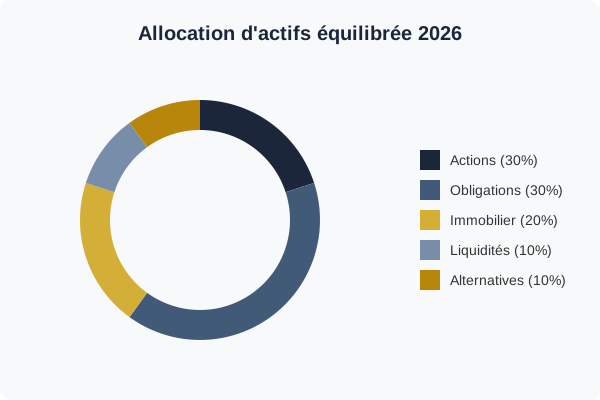
Visualization of a balanced portfolio in 2026: Equities, Real Estate, Gold and Bonds.
In 2026, the quest for the "Efficient Frontier"—that perfect balance between risk and return—requires combining assets whose performance drivers are different.
The 2026 Context: Why Old Recipes Have Expired
For decades, the "60/40" portfolio (60% equities, 40% bonds) was the absolute gold standard. But in 2026, this model is showing its limits. We are observing an increasing correlation between traditional asset classes during market stress phases. When global equities drop due to geopolitical tensions, bonds no longer systematically play their role as a buffer, as persistent inflation weighs on both fronts.
For the modern saver, diversification can no longer be limited to a duel between a basic savings account and the "fonds euros" of a French life insurance policy (Assurance-Vie). It must become multidimensional.
Beyond Paper: The Importance of Real Assets
True diversification in 2026 involves integrating tangible assets. Real estate remains a cornerstone, but it must itself be diversified. Don't just own your primary residence or a basic rental property. Look towards REITs (Real Estate Investment Trusts) or SCPIs, which allow exposure to office, logistics, or healthcare real estate, with risk pooled across hundreds of tenants.
Gold, often described as a "barbaric relic," has regained all its luster in 2026 as the ultimate protective asset. In a modern portfolio, it acts as insurance against systemic risks.
The Trap of "False Diversification"
This is the most common mistake I encounter during my portfolio audits. An investor thinks they are diversified because they hold ten different stock lines. But if those ten companies are all American tech giants, they aren't diversified: they are overexposed to a single sector and geographical area.
Correlation is the wolf hiding in the woods. In 2026, some assets previously thought to be uncorrelated, such as certain cryptocurrencies and tech indices, are actually moving in concert. To identify these hidden correlations, a detailed analysis of your wealth is essential.
Typical Allocation Models for 2026
1. The "Balance & Serenity" Profile (Prudent to Moderate)
This profile aims to protect capital while seeking returns above inflation.
- 30% Cash / Money Market Funds: For immediate liquidity.
- 20% Corporate Bonds (Investment Grade): For regular yields.
- 20% Diversified Real Estate (Europe/Healthcare): For income uncorrelated with stock markets.
- 20% World Equities (via low-volatility ETFs): To capture global growth.
- 10% Gold and Real Assets: For inflation protection.
2. The "Growth & Opportunities" Profile (Dynamic)
For those with a long time horizon (over 10 years) who accept short-term volatility.
- 50% Global Equities: Focused on future themes (AI, Energy Transition, Healthcare).
- 15% Private Equity: To invest in the non-listed real economy.
- 15% Diversification Real Estate (Logistics/Data Centers): For resilience.
- 10% Emerging Market Bonds: For yield seeking.
- 10% Alternative Assets (Commodities / Regulated Crypto-assets).
Expert Opinion: Don't Stay Static
Diversification is not a one-time act; it is a process. Over time, your best-performing assets will take up a larger share of your portfolio, changing your risk profile without you even noticing. This is known as "allocation drift."
It is crucial to perform an annual rebalancing. This involves selling a portion of your assets that have increased the most to buy back those that have temporarily declined. Paradoxically, this is a mechanical way to "sell high and buy low," while maintaining your initial risk level.
Diversification is your best ally for navigating the storms of 2026. But before taking action, one question remains: do you really know your risk tolerance in this new financial environment?
🚀 Actionable Advice: Take the Test
Diversification begins with self-knowledge. Before modifying your portfolio, diagnose your 2026 investor profile.
Start the Wealth Quiz →Estimated time: 5 minutes. Immediate and free result.




Commentaires (0)
Soyez le premier à laisser un commentaire sur cet article.
Laisser un commentaire