EXPATRIATION: THE COMPLETE 2026 TAX GUIDE
Master your change of tax residency and secure your assets when moving abroad.
Introduction: Leaving with Peace of Mind, but in Compliance
The project of a life abroad is an exhilarating adventure. Whether for a professional opportunity, retirement in the sun, or an entrepreneurial project, expatriation changes everything. But amidst the boxes and visas, a crucial question is often pushed to the background: that of your new fiscal reality.
France has one of the most complex tax systems in the world, and crossing the border does not automatically sever all ties with the French tax authorities. In 2026, with the acceleration of the automatic exchange of information between countries, there is no more room for improvisation. This guide gives you the keys to a successful tax transition.
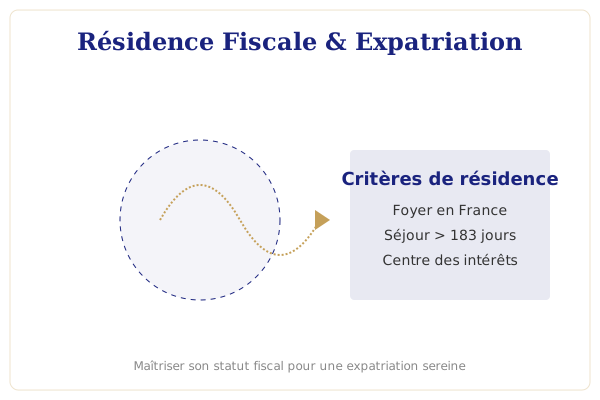
1. Determining Your Tax Residency
This is the cornerstone of your taxation. Are you still a French tax resident or have you become a non-resident?
1.1 French Law Criteria (Article 4 B of the CGI)
You are considered a French tax resident if you meet any one of these four criteria:
- Your household (spouse and children) remains in France.
- Your main place of stay is France (more than 183 days per year).
- You carry out a professional activity in France (salaried or otherwise).
- The center of your economic interests is located in France (main source of income, headquarters of your business).
1.2 International Treaties: Your Shield Against Double Taxation
In case of conflict between two countries claiming you as a resident, international tax treaties prevail over domestic law. They provide "tie-breaker" criteria (permanent home, center of vital interests, etc.) to prevent you from being taxed twice on the same income.
2. Leaving France: Formalities and Exit Tax
Before leaving, certain steps are essential to avoid unpleasant surprises.
2.1 The Exit Tax: For "Large" Portfolios
If you hold direct or indirect stakes in companies representing at least €800,000 or 50% of a company's profits, you could be subject to the Exit Tax. This mechanism aims to tax unrealized capital gains at the time of departure. Fortunately, an automatic deferral of payment is often granted if you move to an EU country or one that has signed an administrative assistance agreement with France.
2.2 Tax Clearance: Is It Still Necessary?
Tax clearance (quitus fiscal) is no longer required for most taxpayers, but you must imperatively report your new address to your tax office and file your tax return the year following your departure (form 2042-NR for the post-departure period).
3. Taxation of Non-Residents on French Income
Even as an expatriate, your French-source income remains taxable in France according to specific rules.
| Type of Income | Typical Taxation for a Non-Resident |
|---|---|
| Rental Income (Real Estate in France) | Minimum rate of 20% (or 30%) + Social levies (7.5% or 17.2%) |
| Dividends & Interest | Withholding tax (often 12.8% or according to treaty) |
| French-source Salaries | Withholding tax by brackets (0%, 12%, 20%) |
Social Levies (CSG/CRDS): The 7.5% Rule
Since recent reforms, non-residents covered by a social security scheme of an European Economic Area (EEA) country, Switzerland, or the United Kingdom (under certain conditions) are exempt from CSG and CRDS on their French real estate income and capital gains. They remain subject only to the 7.5% solidarity levy.
Note: For expatriates outside Europe (USA, Asia, Middle East), the full rate of 17.2% generally applies.
4. IFI (Real Estate Wealth Tax)
If you are a non-resident, you are only taxable for IFI in France on your real estate assets located in France (held directly or through companies like SCPIs), if their net taxable value exceeds €1.3 million. Your financial assets (bank accounts, securities) and your real estate assets located abroad are out of scope.
Official Sources & Documentation

Thomas, Expert en Stratégie Patrimoniale
Fort de 15 ans d'expérience en gestion de fortune, Thomas décrypte les mécanismes complexes de la finance pour les rendre accessibles à tous. Il accompagne les investisseurs dans l'optimisation fiscale et la construction de patrimoines pérennes.