INVESTING IN SME CAPITAL (IR-PME): THE COMPLETE 2026 GUIDE
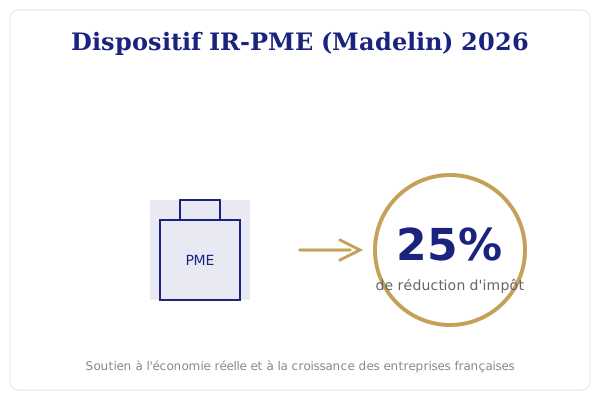
Supporting the real economy while reducing your income tax by up to 25%.
Introduction: Why SMEs are at the Heart of Tax Optimization?
In a financial landscape often dominated by intangible assets and volatile markets, investing in the capital of Small and Medium-sized Enterprises (SMEs) offers an attractive alternative. This is the IR-PME scheme, also known as the "Madelin Law".
Investing in an SME is, above all, about giving meaning to your savings. It's choosing to finance innovation, employment, and growth within our territory. But for the taxpayer, it is also a remarkably effective fiscal lever, allowing for a significant portion of income tax to be offset starting the year following the investment.
1. The IR-PME Mechanism in 2026
The IR-PME scheme allows taxpayers tax-domiciled in France to benefit from an income tax reduction equal to a percentage of their payments made into the capital of unlisted SMEs.
1.1 What is the reduction rate for 2026?
For the year 2026, the reduction rate is maintained at 25% for investments in solidarity press companies, solidarity real estate companies, and under certain conditions validated by the European Commission for other SMEs. The standard rate remains fixed at 18%.
| Investment Type | 2026 Reduction Rate |
|---|---|
| "Classic" SME (Madelin eligible) | 18% to 25%* |
| Innovative Young Enterprise (JEI) | 30% to 50% (depending on status) |
| ESUS (Social Utility Solidarity Enterprise) | 25% |
*Subject to the publication of application decrees for the increased rate.
2. Eligibility Conditions
To benefit from this tax advantage, several conditions must be met by both the investor and the recipient company.
For the investor:
- Must be a natural person tax-domiciled in France.
- Commit to holding the securities until December 31st of the fifth year following the subscription.
- Cannot benefit from other tax advantages for the same investment (no accumulation with PEA).
For the company (SME):
- Must be an SME in the European sense (fewer than 250 employees, turnover < €50M).
- Have its registered office in an EU (or EEA) member state.
- Carry out a commercial, industrial, artisanal, liberal, or agricultural activity.
- Be in the creation or development phase (less than 7 years after its first sale).
3. Caps and Carryover: Valuable Flexibility
Payments are taken into account within an annual limit of:
- €50,000 for a single person.
- €100,000 for a married or civilly partnered couple (subject to joint taxation).
Good to know: If the reduction amount exceeds the tax due or the global tax niche cap, the excess is carryable over the following 4 years. This is a major asset for large investments that would exceed the global tax niche cap (€10,000).
⚠️ Risks to Consider
Investing in SME capital involves risks that should not be overlooked:
- Risk of total or partial loss of capital: SMEs are inherently fragile.
- Illiquidity risk: It is difficult to sell shares before the term, or even after if there is no buyer.
- No guaranteed return: Dividends are never certain.
Expert advice: Never devote more than 5% to 10% of your overall financial assets to this type of investment.
4. How to Invest in 2026?
There are three main ways to access SME capital:
- Direct Investment: You enter the capital of a company you know (friends, family, local network).
- Crowdequity: Via regulated crowdfunding platforms.
- Funds (FIP / FCPI): You delegate management to professionals who select a basket of SMEs. Note: Rates and caps are different for funds.
Official Sources & Documentation

Thomas, Expert en Stratégie Patrimoniale
Fort de 15 ans d'expérience en gestion de fortune, Thomas décrypte les mécanismes complexes de la finance pour les rendre accessibles à tous. Il accompagne les investisseurs dans l'optimisation fiscale et la construction de patrimoines pérennes.